What You Really Need to Know Before Digging Down

If you’ve typed “basement extension cost Essex” or “can I build a basement under my house?” into Google, you’re probably at one of two points:
- You love your home but need more space
- Moving feels expensive, stressful, or unnecessary
Basements can be brilliant. They can also be complicated, expensive, and risky if handled badly.
At Connor Ferris Architects, we’ve seen both ends of the spectrum. So this guide is not sales-heavy it’s practical. Here’s what you actually need to know.
Why Are More Homeowners Considering Basements?
In areas like Chelmsford, Brentwood, Billericay, Epping and Greater London, space is tight and house prices are high. Often:
- The loft has already been converted
- Permitted development limits have been reached
- The garden is too small to extend further
- Planning constraints restrict visible additions
Digging down avoids altering the street scene and can preserve valuable outdoor space.
In London boroughs such as Kensington, Camden and Islington, basement extensions have become almost standard on high-value homes. In Essex, we’re seeing steady growth usually for cinema rooms, gyms, guest suites or large open-plan living spaces.
The First Honest Question: Is It Worth It?
This depends entirely on three things:
1️⃣ Your Property Value
If your house is worth £450k, a £180k basement may not stack up financially.
If it’s worth £1.2m+, the equation changes.
2️⃣ The Type of Space You Need
Basements work best for:
- Cinema rooms
- Gyms
- Playrooms
- Guest bedrooms
- Utility spaces
- Hybrid office / studio spaces
They are less effective if you want your main family kitchen-living area underground unless natural light is handled properly.
3️⃣ Your Ground Conditions
Soil type, water table level and neighbouring foundations matter. A structural engineer’s input is essential early on.
A feasibility study is not optional with basements it is critical.
Planning Permission: Do You Need It?
Usually, yes.
Unlike many rear extensions, basements rarely fall neatly under permitted development. Councils look closely at:
- Flood risk
- Structural impact on neighbours
- Drainage
- Party Wall implications
- Lightwell impact
In parts of London, some boroughs require Basement Impact Assessments. In Essex, it depends on site constraints.
Even if planning isn’t complex, Building Regulations absolutely will be. Waterproofing design under BS 8102 is mandatory and must be specified properly.
The Biggest Risks (And How To Avoid Them)
Basements fail when:
- Waterproofing is an afterthought
- Structural design is rushed
- Temporary works are underestimated
- Contractors lack basement experience
Common issues include:
- Damp and mould
- Water ingress
- Structural cracking
- Poor ventilation
- Low ceiling heights that feel oppressive
The key is coordination architect, structural engineer, waterproofing specialist and contractor must align from day one.
What Does a Basement Cost in Essex & London?
Realistically:
- Converting an existing cellar: £1,500–£2,500 per m²
- New excavation: £3,000–£5,000+ per m²
- High-spec London schemes: significantly higher
Costs increase if:
- Access is restricted
- Underpinning is extensive
- Drainage needs relocating
- Lightwells are required
- Neighbouring foundations are shallow
Basements are rarely “cheap extra space.” They are premium space.
How To Make a Basement Feel Like Proper Living Space
This is where good design matters most.
We focus on:
✔ Maximising ceiling height
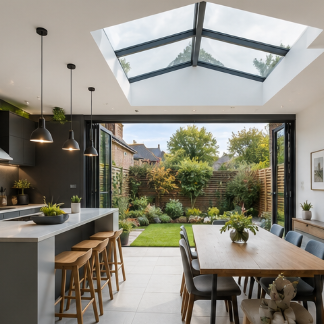
✔ Bringing in natural light via lightwells and glazing
✔ Mechanical ventilation with heat recovery
✔ Robust waterproofing systems
✔ Clear circulation and escape routes
✔ Designing it as primary space not leftover space
A well-designed basement should not feel like a basement.
When We Advise Clients Not To Do It
We regularly tell people no.
If:
- The numbers don’t stack up
- The resale ceiling is too low
- Flood risk is high
- Access for construction is extremely constrained
- The disruption outweighs the benefit
Sometimes a reconfiguration above ground is smarter.
Honest advice protects both your investment and our reputation.
What the Process Actually Looks Like
- Initial discussion and property review
- Feasibility assessment
- Measured survey
- Concept design
- Planning application (if required)
- Structural coordination
- Technical design (RIBA Stages 0–4)
- Building Regulations package
- Contractor engagement
Basement projects take longer than standard extensions. Programme planning is essential.
Is a Basement Right for Your Home in Essex?
If you’re in Chelmsford, Brentwood, Billericay or Greater London and you’re:
- Struggling for space
- Already maximised upward extensions
- Living in a high-value property
- Considering long-term investment rather than moving
A basement could be worth exploring.
If you’re unsure, the first step isn’t drawings it’s a feasibility conversation.
Thinking About a Basement?
We’re happy to review your property and give you a clear view on:
- Technical viability
- Planning risk
- Rough cost expectations
- Whether it makes financial sense
No pressure just informed guidance.