For many homeowners across Essex, extending your home can feel confusing before the project has even started. One of the most common questions we are asked at Connor Ferris Architects is:
“Do I actually need planning permission for my extension?”
The answer is: sometimes yes, sometimes no.
Many home extensions in Essex can actually be built under something called Permitted Development Rights, meaning formal planning permission may not be required. However, this depends entirely on the size of the extension, the type of property, your location, and the specific design proposal.
Unfortunately, many homeowners assume they are covered under Permitted Development, only to later discover their project requires planning approval, resulting in delays, redesigns, and unnecessary costs.
This guide explains how planning permission works for extensions in Essex, what can often be built without permission, and when you should involve an architect early in the process.
What is Permitted Development?
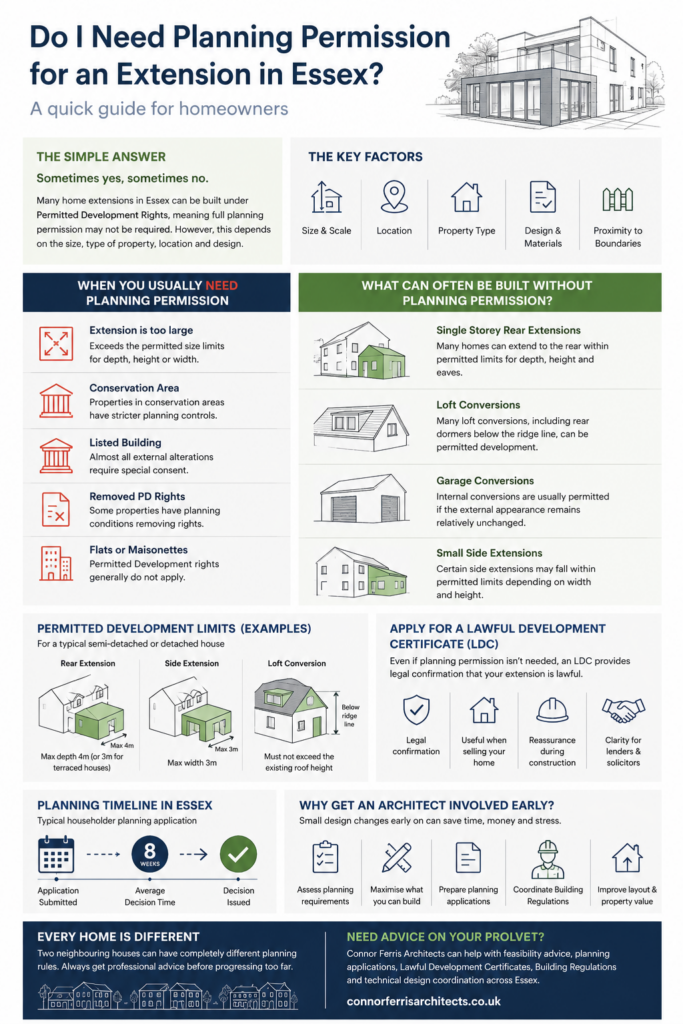
Permitted Development Rights are national planning rules that allow certain types of home improvements and extensions to be carried out without submitting a full planning application.
These rights commonly apply to:
- Single storey rear extensions
- Side extensions
- Loft conversions
- Garage conversions
- Certain outbuildings
However, there are strict rules relating to:
- depth
- height
- materials
- roof design
- proximity to boundaries
- overall percentage increase of the original house
Even small design changes can move a project outside Permitted Development.
Across Chelmsford, Brentwood, Billericay, Maldon, and wider Essex, we regularly see homeowners assume a project is “definitely permitted” based on something a neighbour has done, when in reality every property is assessed individually.
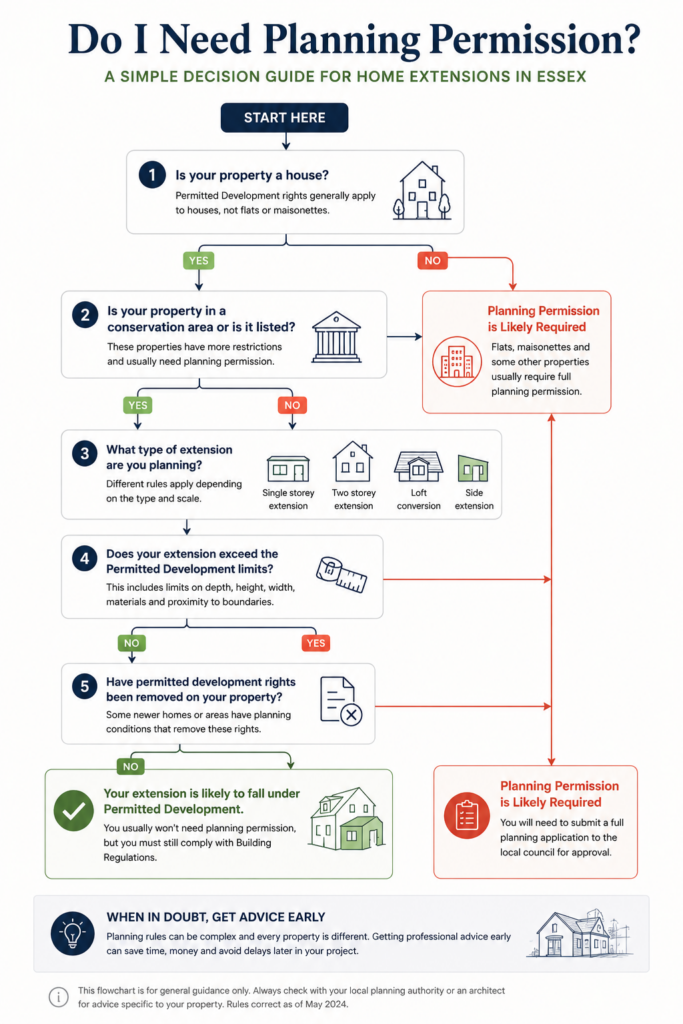
When You Usually DO Need Planning Permission
In Essex, planning permission is commonly required when:
Your Extension is Too Large
If the extension exceeds the permitted development size limits, a full planning application will normally be needed.
This often applies to:
- large wraparound extensions
- deep rear extensions
- double-storey side extensions
- oversized loft conversions
Your Property is in a Conservation Area
Properties located within conservation areas often have more restricted development rights.
Parts of:
- Chelmsford
- Maldon
- Epping
- Colchester
- Brentwood villages
may have tighter planning controls designed to protect local character.
Your Home is Listed
If your property is listed, almost all external alterations will require consent, even relatively minor changes.
Previous Owners Removed Permitted Development Rights
Some newer developments across Essex have planning conditions attached removing normal development rights. This is more common than many homeowners realise.
You Live in a Flat or Maisonette
Permitted Development rights for extensions generally apply to houses, not flats or maisonettes.
What Can Often Be Built Without Planning Permission?
While every project should be reviewed professionally, the following are commonly achievable under Permitted Development:
Single Storey Rear Extensions
Many semi-detached and detached homes can extend several metres to the rear without full planning permission, subject to design criteria.
Loft Conversions
A large number of loft conversions in Essex are completed under Permitted Development, particularly rear dormers that remain below the ridge line.
Garage Conversions
Internal garage conversions often do not require planning permission if the external appearance remains relatively unchanged.
Small Side Extensions
Certain side extensions may also fall within permitted limits depending on width and height restrictions.
A Common Mistake Homeowners Make
One of the biggest mistakes is relying purely on online advice or builder assumptions before drawings are prepared properly.
Planning rules are highly technical.
Something as small as:
- roof height
- eaves position
- cladding materials
- window placement
- proximity to a boundary
can completely change whether approval is required.
We often see homeowners spend money progressing designs, speaking to builders, or obtaining quotations before properly establishing the planning position.
Should You Still Apply for Something if Planning Permission Isn’t Needed?
In many cases, yes.
Even where an extension falls under Permitted Development, we commonly recommend applying for a:
Lawful Development Certificate (LDC)
This is an official certificate from the council confirming the extension is lawful.
It provides:
- legal confirmation for future house sales
- reassurance during construction
- protection against future disputes
- clarity for mortgage lenders and solicitors
Many Essex homeowners skip this stage and later encounter issues when selling the property.
How Long Does Planning Permission Take in Essex?
Most householder planning applications typically take around:
- 8 weeks for a decision
However, this can vary depending on:
- the local authority
- conservation constraints
- objections
- design revisions
- validation delays
Councils across Essex such as Chelmsford City Council, Brentwood Borough Council and Basildon Borough Council may all interpret policies slightly differently depending on the site context.
How an Architect Can Help
An experienced architect does far more than simply produce drawings.
At Connor Ferris Architects, we help homeowners across Essex:
- assess whether planning permission is required
- maximise what can be achieved under Permitted Development
- prepare planning applications
- coordinate Building Regulations
- improve layouts and property value
- reduce costly design mistakes later in the project
Often, small design adjustments early in the process can avoid the need for full planning permission entirely.
Final Thoughts
There is no universal answer to whether you need planning permission for an extension in Essex.
Two neighbouring houses on the same road can have completely different planning constraints depending on:
- previous approvals
- property type
- conservation status
- site conditions
- design approach
The safest approach is always to have the project reviewed properly before progressing too far.
If you are considering a home extension in Chelmsford, Brentwood, Billericay or wider Essex, Connor Ferris Architects can assist with feasibility advice, planning applications, Lawful Development Certificates, Building Regulations and technical design coordination.